Professional pipe leak detection for Carson and South Bay homes.
A hidden leak wastes water, weakens framing, and feeds mold long before a stain ever appears. Carson Pipe Pros uses an acoustic listening device, thermal imaging, and pressure testing to pinpoint leaks in Carson and South Bay homes before any wall is opened. Call (123) 456-7890 to schedule detection when your bill climbs or the meter will not stop moving.
Most damaging leaks never announce themselves with a flood. A pinhole in a copper pipe inside a wall, a slow drip at an angle stop, or a supply line weeping behind a washing machine can run for weeks while the only clues are a water bill that crept up, a faint musty smell, or paint that feels soft in one small spot. By the time a stain shows, the framing and insulation have usually been wet for a while.
Carson has many homes built during the postwar growth of the South Bay, and their original plumbing is now well into old age. Galvanized steel, early copper, and aging ABS drains all develop slow failures rather than dramatic ones. Leak detection exists for exactly this pattern: find the small, quiet failure early, while the repair is still a pipe repair and not a room rebuild.
Homeowners often sense a leak before they can point to it. The house sounds different at night, with a faint hiss or ticking in one wall. A pet fixates on one baseboard. One bathroom never loses its damp smell even after cleaning. These soft clues matter because leaks respect plumbing runs, not room boundaries, and a supply line feeding a bathroom in a Carson ranch home may travel through a kitchen wall and a hallway before it reaches the fixture where damage finally shows. Noting where a sound or smell seems strongest gives the detection visit a starting map to test against the instruments.
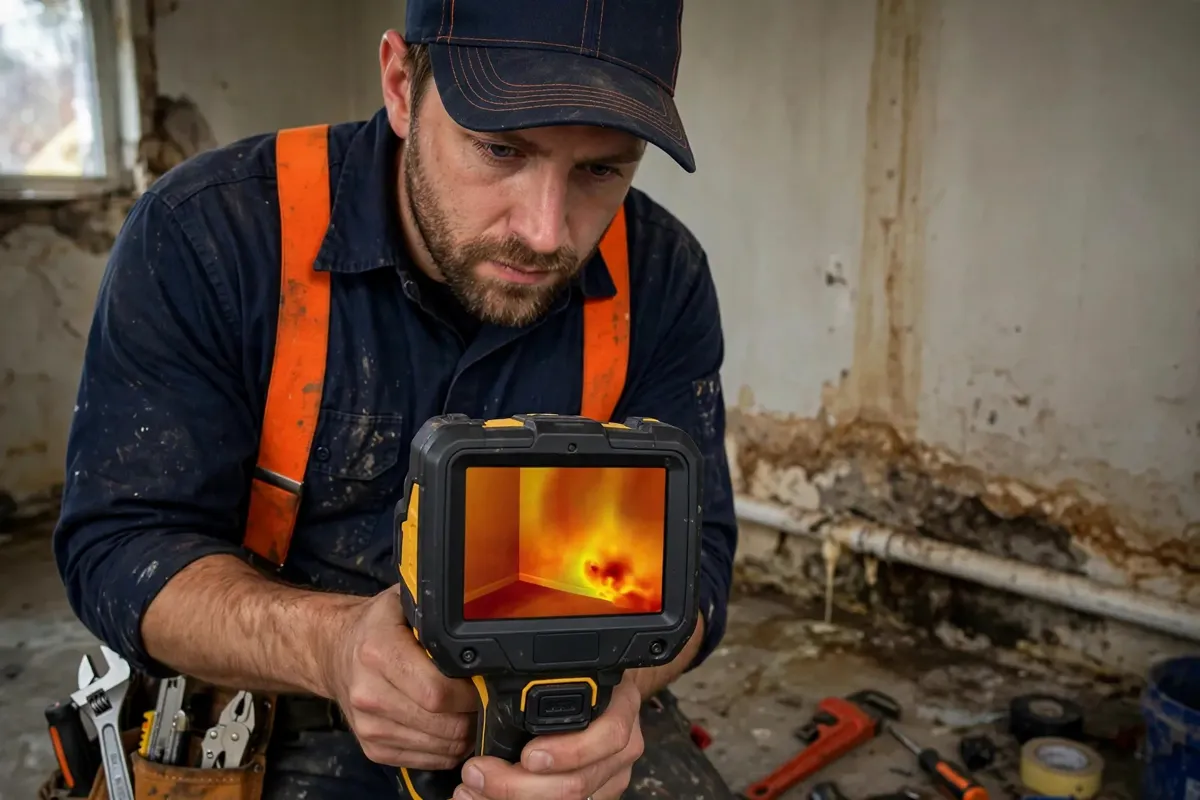
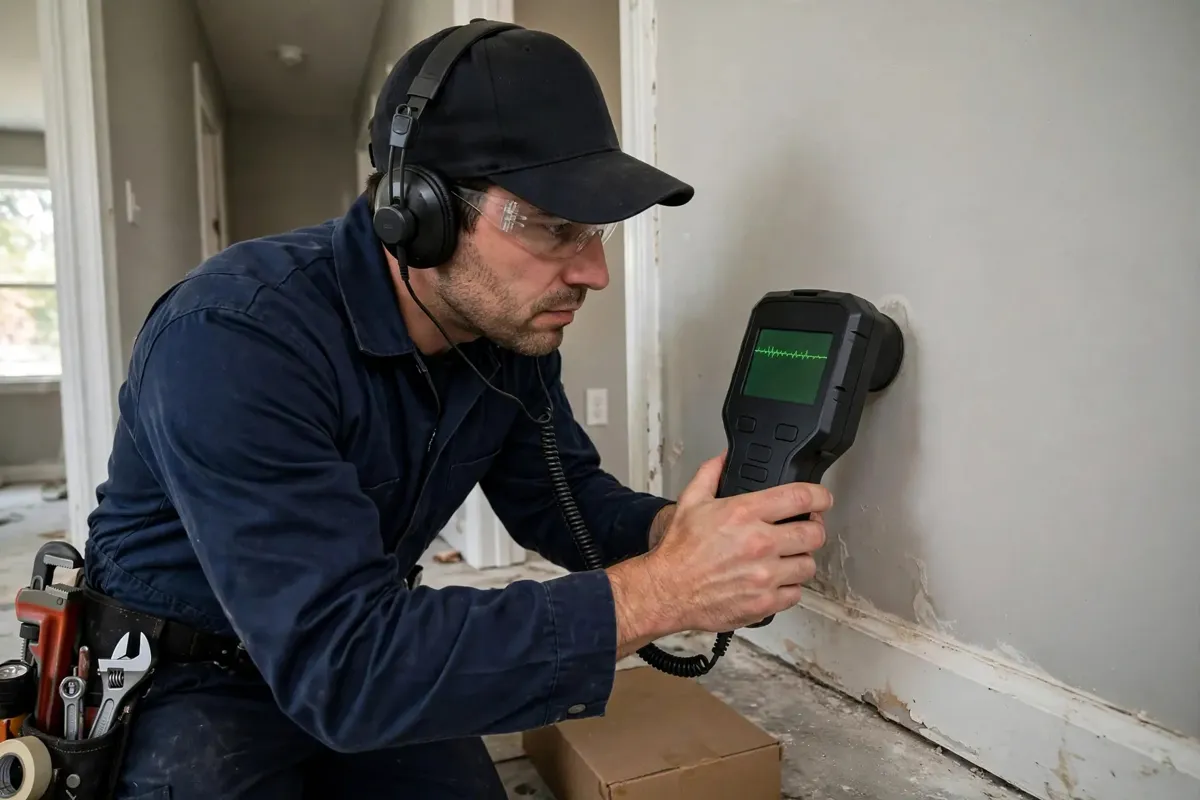
Pressurized water escaping a pipe makes sound, even through drywall and concrete. An acoustic listening device amplifies that sound so a trained ear can follow it along the line and narrow the leak to a small area. Thermal imaging adds a second view, showing the cool trail of water spreading from a hot or cold line inside a wall or under a floor, without opening anything yet.
A moisture meter confirms what the first two tools suggest. Readings taken in a grid around the suspect area show where moisture is highest and how far it has spread, and those readings also create a baseline for checking that the area is truly dry after the repair. No single tool decides alone. The leak is marked where listening, imaging, and moisture all point to the same place.
Experience matters alongside equipment because buildings make noise of their own. Traffic on Wilmington Avenue, wind against siding, and appliances cycling can all confuse an untrained listener, and thermal images must be read with sun load and insulation gaps in mind. A careful technician repeats readings from several angles, shuts down competing noise where possible, and marks a location only when the evidence converges. That discipline is what separates a confident small opening in the right stud bay from a series of exploratory holes, and it is why detection reports describe a pinpointed area rather than a general neighborhood of suspicion.
Older homes rarely match their original plans. Lines were moved during remodels around neighborhoods like those near Veterans Park and along Sepulveda Boulevard, valves were buried, and repairs from different decades used different materials side by side. A copper pipe may meet PEX from a recent remodel, and a galvanized steel stub may still feed one bathroom. Detection has to follow the system as it actually exists, not as it was drawn.
The visit works systematically: confirm the leak with a meter test, isolate sections with the main shutoff and any isolation valve in the system, then test each branch. A hydrostatic pressure test on a suspect section confirms whether it holds or drops. That step by step process is what keeps the eventual opening small, targeted, and in the right place the first time.
Supply leaks and drain leaks behave differently, and older homes often have both aging at once. A pressurized supply leak runs constantly, moves the meter, and answers to pressure testing, while a drain leak appears only when a fixture above it is used, then dries between uses. Testing separates the two early: fixtures are run one at a time while the meter and moisture readings are watched, so a cracked ABS drain is not chased as a copper supply problem or the other way around. That distinction decides the repair approach, the opening location, and the urgency, since constant supply leaks cannot safely wait.
How do plumbers find a hidden water leak? The process starts with proof. The water meter is watched with every fixture off. If the meter still moves, water is leaving the system somewhere. A hydrostatic pressure test then confirms the loss and, by isolating branches one at a time, points to the part of the house where the leak lives.
Within that zone, the acoustic listening device follows the sound of escaping water, thermal imaging maps the wet pattern, and a moisture meter verifies saturation in walls and floors. For drain leaks, the method changes: a sewer camera through a cleanout can show a cracked ABS or cast iron drain from the inside, and controlled water tests reproduce the leak on demand.
Only after the location is confirmed does anything get opened, and the opening is sized to the repair, not to the search. When you call (123) 456-7890, note any clues you have noticed: a warm spot on the floor, a sound at night, a bill change, or a room that smells musty. Those details genuinely shorten the search.
The same method also protects finished spaces that homeowners fear losing. A detection plan for a tiled bathroom in a Carson home starts with every noninvasive tool available, camera views through access points, moisture mapping across grout lines, and isolation testing of that bathroom branch alone, so that any eventual opening lands in the least visible, most repairable place possible. Often that is inside a vanity base, a closet wall, or an access panel location that can be restored cleanly, rather than through the tile face itself, and reaching that outcome is the practical difference careful detection makes.
A small leak does not stay small in its effects. Constant moisture swells wood, rusts fasteners, softens drywall, and creates the damp, dark conditions mold prefers inside wall cavities. A pinhole spray can also damage the back of cabinets and the subfloor below while the visible room still looks normal, which is why the repair bill grows with time even though the hole itself barely changes.
The pipe itself gets worse too. A pinhole in copper often signals wall thinning in that section, and a weeping compression fitting or solder joint can work looser under pressure cycles. Water loss adds up quietly across weeks of a running leak, and in a slab or foundation area, escaping water can undermine the soil supporting the concrete.
Finding a leak early keeps every part of the job smaller: smaller opening, shorter repair, less drying, less rebuilding. If your meter moves when nothing is running, or one area of the home never quite dries out, that is the right time to call (123) 456-7890 rather than waiting for a stain to make the decision for you.
A simple habit catches many leaks while they are still small. Read the water meter on a quiet morning before any use, then read it again after a workday when the house has been empty, and write both numbers down. A change with no use in between is a leak announcing itself in arithmetic. Pair that habit with a twice yearly look under every sink, behind every toilet, and around the water heater, feeling each angle stop and supply line for dampness, and most hidden leaks lose their hiding place long before drywall stains or flooring damage force the discovery on a much worse schedule.
Straight answers before you call.
Describe what your pipes are doing and we will point you to the right next step.
Call (123) 456-7890Watch the water meter with all fixtures off, note unexplained bill increases, and check for musty smells, soft paint, or warm floor spots. Any of those is a reason to schedule detection.
The detection itself is noninvasive, using listening equipment, thermal imaging, and moisture readings. A small opening is made only after the leak location is confirmed, sized for the repair.
Yes. Slab and subfloor leaks can run for a long time before surface signs appear, which is why meter and pressure testing matter even when rooms look dry.
A section of pipe is isolated and pressurized, then watched. If pressure drops, that section is losing water, which narrows the search before acoustic tools pinpoint the spot.
If water is actively damaging the home, close the main shutoff and call (123) 456-7890. For a suspected slow leak with no active damage, note the meter reading and call for detection.
Burst pipes shut off, located, and repaired fast, day or night.
Water extraction, drying, and cleanup after a pipe failure.
Camera inspection and repair for cracked, root filled, and collapsed sewer lines.
Snaking and hydro jetting for drains that keep slowing down or backing up.
Call now and describe what is happening. We will take it from there.
Call (123) 456-7890