Professional gas line repair for Carson and South Bay homes.
A gas smell, a failing appliance, or a line damaged during yard work all call for calm, prompt action and qualified repair. Carson Pipe Pros pressure tests gas lines in Carson and South Bay homes, locates the leaking section, and repairs or replaces it with verified testing afterward. Call (123) 456-7890 after leaving the area and addressing immediate safety first.
Natural gas is odorless on its own, so utilities add the rotten egg scent deliberately to make leaks noticeable. If that smell appears near a water heater, stove, furnace, dryer, or meter in your Carson home, treat it as real until proven otherwise. Leave the area, avoid switches, phones, and flames inside the space, and once you are outside and clear, make your calls from there.
Not every gas issue announces itself by smell. An appliance that will not light, a burner with a weak or uneven flame, dead patches of grass over a buried line in the yard, or a hissing sound near piping can each point to a supply problem. Older South Bay homes may still have aging steel gas runs and valves that have not been operated in years, which is reason enough to have concerns checked rather than lived with.
Appliance behavior can report a gas problem before odor does. A water heater that repeatedly loses its pilot, a furnace that lights with a lazy yellow flame instead of a crisp blue one, or soot marking around a burner compartment all suggest combustion or supply trouble worth professional attention. None of these signs should be adjusted away by a homeowner turning valves or cleaning parts inside a gas appliance, because the same symptom can arise from venting, pressure, or a failing gas control, and each cause demands its own verified correction before the appliance returns to regular service in the home.
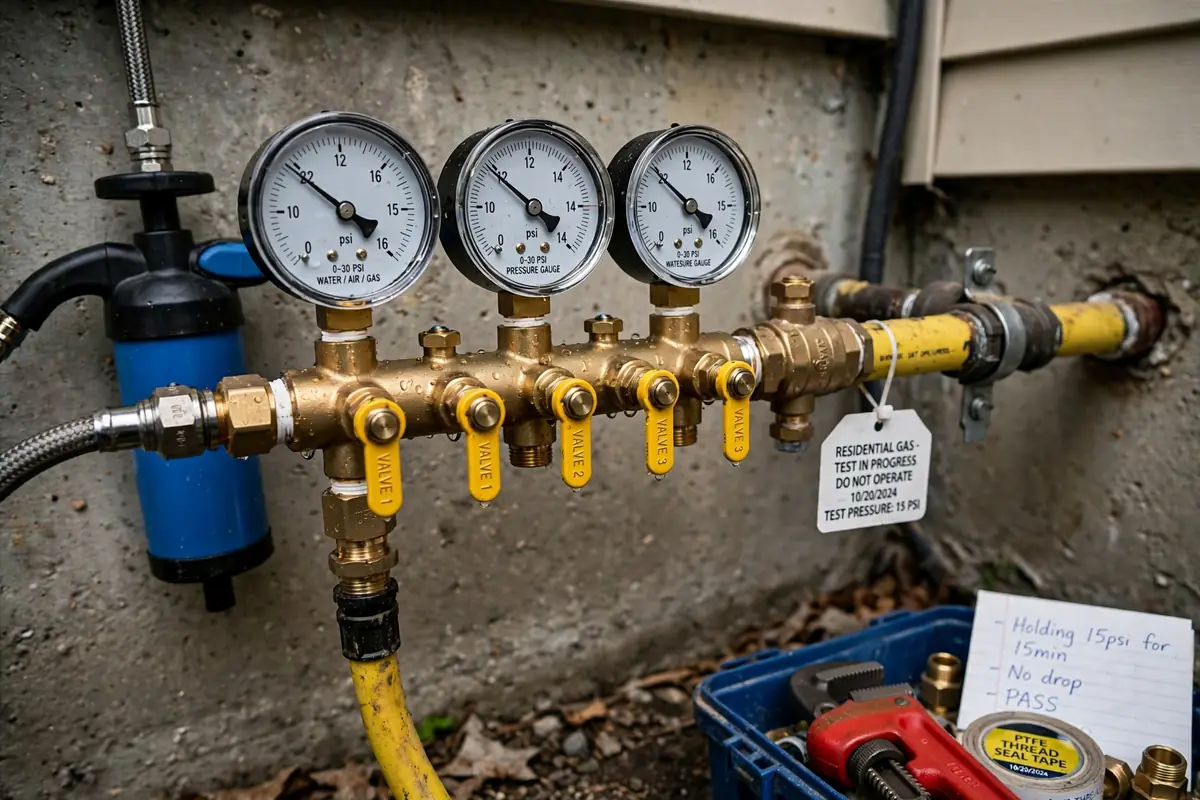
Finding a gas leak is methodical work. The system is isolated at the meter and at individual appliance branches using each shutoff and isolation valve, then a hydrostatic pressure test, adapted for gas lines with the proper test medium and gauges, shows whether the system holds pressure or loses it, and which branch is responsible. Joints and fittings are then checked directly to confirm the exact point.
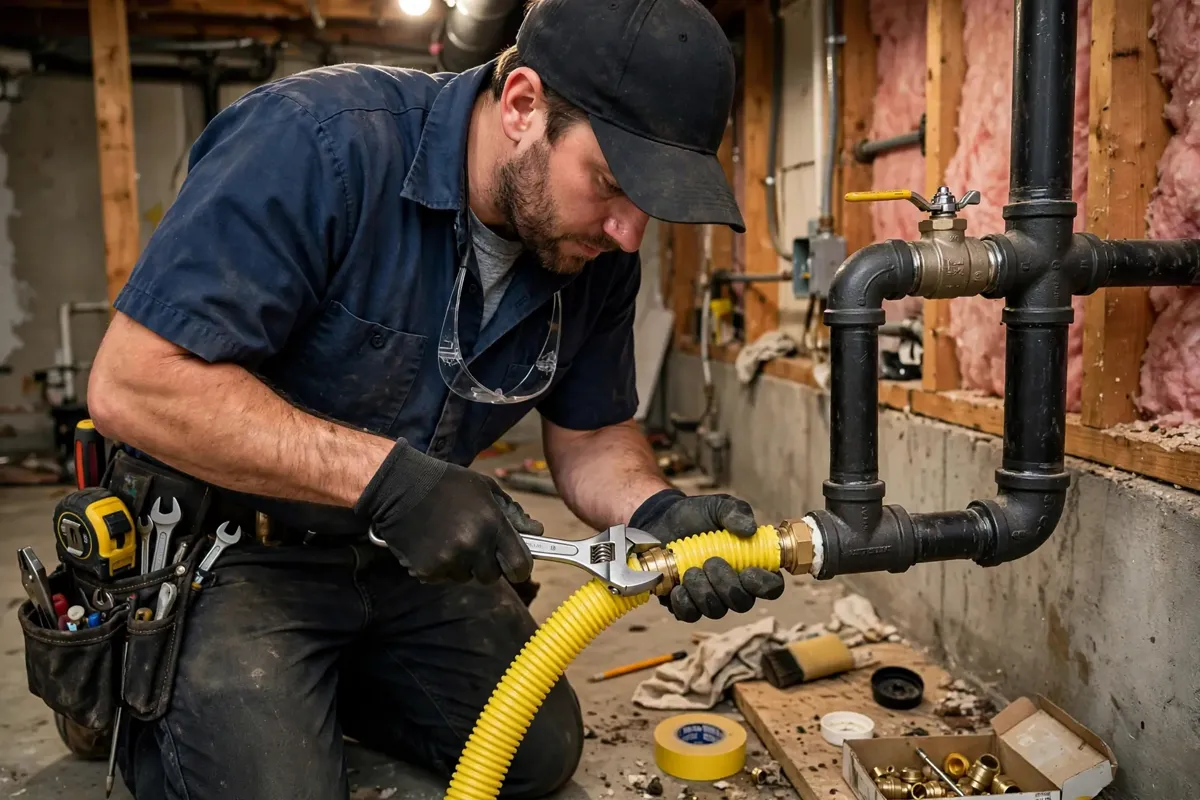
Repair follows the finding. A failed fitting may be remade, a corroded section of pipe replaced, or an old valve that no longer seals swapped for a new one, with each appliance reconnected and its supply line and connection inspected. After any repair, the whole system is pressure tested again and each appliance is lit and observed, because a repair is only complete when the full system proves tight under test.
A proper gas test is patient work. Gauges are watched for the full test period rather than glanced at once, because a slow leak at one aging union may take minutes to move a needle, and a system declared tight too quickly has not really been tested at all. Findings are recorded branch by branch, so any later work starts from a map of what held and what did not. That record, paired with clear labeling of each shutoff found and exercised during testing, leaves the homeowner safer than before the visit even when a repair turns out to be small and quickly finished.
Most Carson homes run gas to the water heater and furnace first, with dryers, stoves, and increasingly outdoor kitchens, fire features, and pool heaters added over the years. Each addition draws on the same supply, and a line sized for the original house may run short when several appliances call at once, showing up as weak flames or appliances that underperform only when everything runs together.
Gas line work covers both sides of that picture: repairing leaks and corrosion in existing runs, and evaluating capacity and routing when an appliance is added, moved, or upgraded. Lines serving homes near Anderson Park, along Main Street, and across Torrance and Gardena all share the same principle: correct pipe sizing, proper shutoff access at each appliance, and verified pressure from meter to burner are what make the system safe and dependable.
Southern California adds one more consideration: earthquakes. Ground movement can stress rigid gas runs, shift appliances against their connectors, and crack aging fittings without any immediate smell reaching the living space. Many Carson homes have automatic seismic shutoff valves at the meter, and homeowners should know whether theirs does, how it behaves after a tremor, and why it should only be reset after the house system has been checked. After any noticeable quake, a walkthrough that sniffs near appliances, listens for hissing, and glances at the meter is a calm habit that catches the rare problem while it is still small.
What should you do if you smell gas in your home? Leave first and investigate later. Get everyone, including pets, out of the house without stopping to open windows, operate switches, or gather belongings. Gas and a single spark are a dangerous pairing, and no possession or appliance in the home is worth reentering a space with a strong gas odor.
From outside and at a distance, call your gas utility emergency line or local emergency services first for a strong odor, then call (123) 456-7890 for the plumbing side of the repair once the scene is safe. Do not reenter until the utility or responders say the home is clear. If the smell is faint and localized near one appliance, you can close that appliance shutoff if it is right at hand without crossing the space, but leaving and calling remains the safe default.
After the immediate danger is handled, the repair process is the measured work described above: isolate, pressure test, locate, repair, and retest. Rushing that sequence helps no one. A gas line returned to service should carry proof with it, a test that held, appliances relit and burning correctly, and valves you know how to operate if you ever need them again.
How do plumbers test a gas line for leaks? The core method is isolation and pressure. Sections of the system are valved off, a test gauge is connected, and the line is pressurized and watched over a set period. A gauge that holds steady clears that section, while a falling gauge proves a leak exists in it even before the precise joint is found.
Pinpointing follows with direct checks at each fitting, union, valve, and solder joint equivalent in the gas system, using leak detection solution or electronic sniffing equipment suited to the setting. Buried yard lines are traced along their route, and appliance connectors, the flexible supply line behind a dryer or stove, get special attention because they age and are disturbed whenever appliances move.
Testing also happens after any nearby plumbing or yard work, since digging, slab work, and foundation repairs can disturb buried lines without obvious signs. If a line in your Carson or Long Beach home has been struck, shifted, or exposed, a pressure test before it is covered again is simple insurance, and far easier than locating a leak once soil and concrete are back in place over it.
The best time to test a gas line is often when nothing seems wrong. Adding a dryer, replacing a range, or moving a water heater disturbs connectors and valves that may have sat untouched for decades, and a pressure check after such work proves the whole branch rather than trusting each disturbed joint on hope. Likewise, a home purchase in Carson, Torrance, or Long Beach is a natural moment to verify gas integrity alongside the water and sewer systems, since all three share the same trait: they are hidden, they age quietly, and they reward the owner who checks them on a calm schedule.
Straight answers before you call.
Describe what your pipes are doing and we will point you to the right next step.
Call (123) 456-7890Leave the home right away without using switches or phones inside, get clear of the building, and call your gas utility emergency line or emergency services from outside. Call (123) 456-7890 for repair once it is safe.
Yes, gas line testing, repair, and replacement for home appliances are core plumbing work. The line is pressure tested before and after repair so the result is verified.
Low pressure, a partially blocked line, a failing valve, or total demand exceeding the line sizing can all weaken flames. Testing measures pressure at the appliance to find which cause applies.
Each gas appliance should have its own shutoff valve on the line right before it. Turning that valve so the handle sits across the pipe stops gas to that appliance only.
It is a wise precaution in Southern California. Shifting can stress joints and buried lines, and a pressure test confirms the system is still tight before normal use resumes.
Burst pipes shut off, located, and repaired fast, day or night.
Hidden leaks found with acoustic and thermal equipment, no guesswork.
Water extraction, drying, and cleanup after a pipe failure.
Camera inspection and repair for cracked, root filled, and collapsed sewer lines.
Call now and describe what is happening. We will take it from there.
Call (123) 456-7890