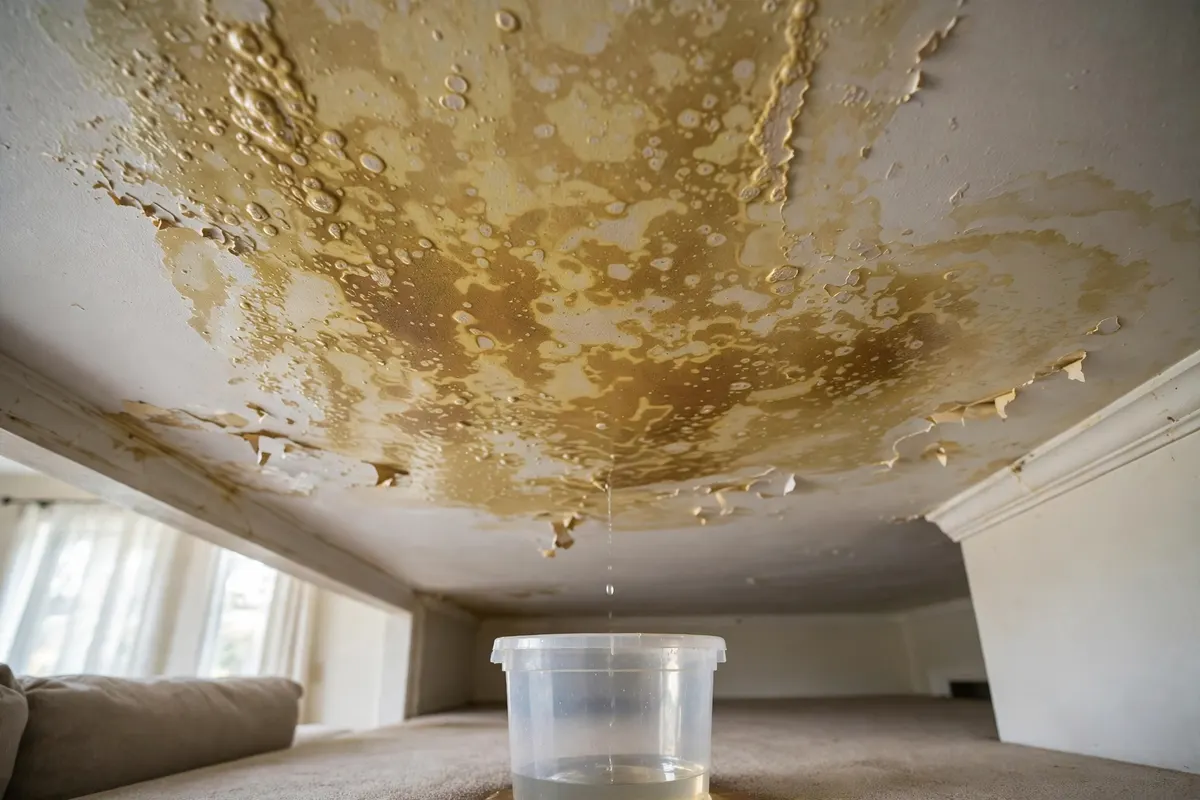
A ceiling stain is your house pointing at a leak it cannot show you directly. Here is how Carson and South Bay homeowners can read the stain, run a few safe checks, and know when to get a plumber moving.
A water stain on the ceiling means water is collecting above the drywall, most often from a supply line pinhole, a bathroom drain or wax ring in the room overhead, or a shower valve leaking behind tile. The stain rarely sits directly under the leak, because water travels along joists and pipe runs before it soaks through. If the stain is growing, dripping, or bulging, shut off the water to that part of the house and call (123) 456-7890.
Homeowners naturally assume the pipe failed right above the brown ring. Sometimes it did. More often, water escaping from a joint or pinhole runs downhill along the top of the drywall, follows a joist, or tracks along a pipe until it finds a seam or a screw hole to soak through. The visible stain can sit several feet from the actual break, which is why cutting the ceiling at the stain so often finds dry pipe and a second, wetter hole gets cut later.
What the stain does tell you reliably is timing and volume. A crisp edged ring that appeared once and never changed usually marks a single past event, like an overflowed tub. A stain with soft edges that keeps expanding, darkening, or growing a bubble in the paint is being fed right now. Touch matters too: a stain that feels cool and damp is active, while a dry, hard stain may be history. Both deserve a meter check, but only one deserves a bucket and a shutoff tonight.
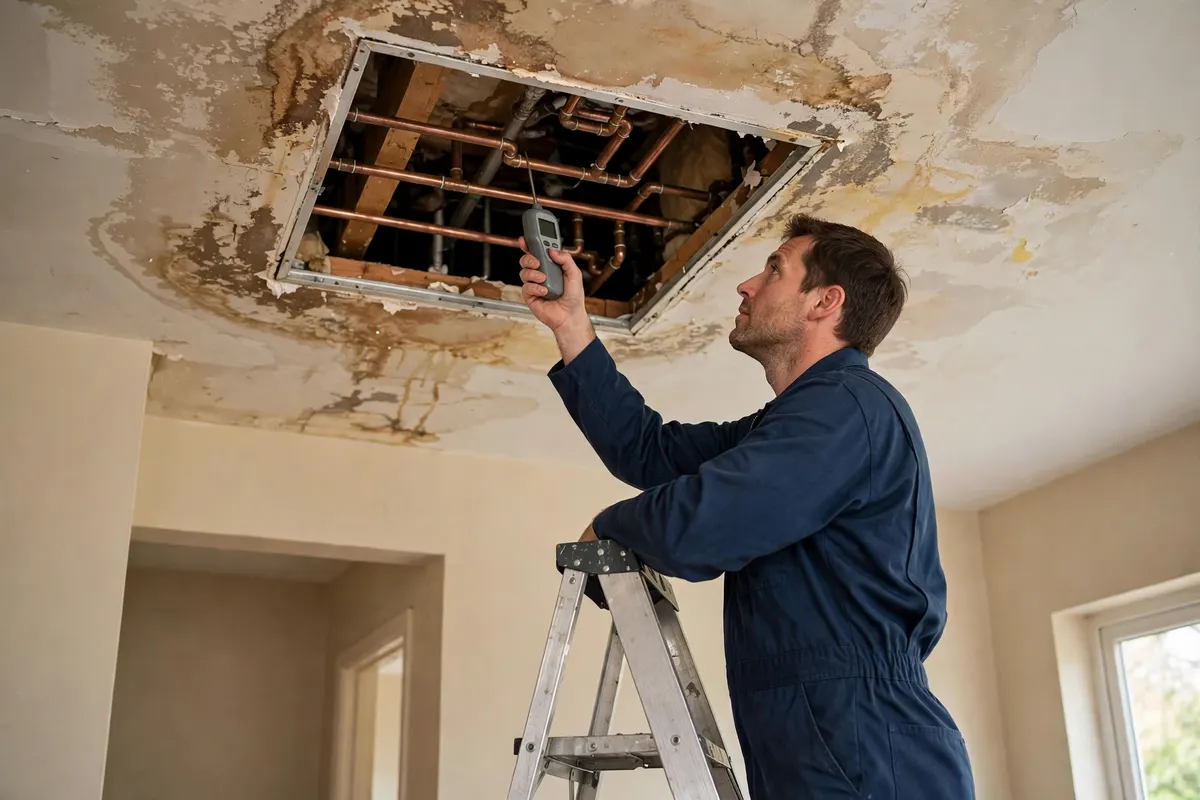
Start with the room overhead, because most ceiling stains in two story South Bay homes are born in a bathroom. Toilet wax rings fail quietly and let a little water escape at every flush, soaking the subfloor around the flange for months before the ceiling below shows it. Shower and tub drains loosen at their gaskets, tub overflow plates leak when the water runs high, and shower valves drip inside the wall long before they drip at the spout.
Supply lines are the second family of causes. A copper pinhole above the ceiling sprays a fine mist that drywall absorbs like a sponge, and a failing fitting on a water heater or softener line in an attic or closet can drip for weeks. Drain lines leak differently: they only release water while the fixture above is running, so the stain grows in pulses that match showers, laundry days, or dishwasher cycles.
The third family is not plumbing at all, and a good diagnosis rules it out honestly. Air conditioner condensate lines clog and overflow their pans in warm months, and roof leaks after a storm can mimic pipe stains almost perfectly. The difference shows in the pattern: condensate and roof water follow weather and cooling cycles, while pipe leaks follow your water use and your water meter.
Begin with a pencil, not a saw. Trace the outline of the stain lightly and write the date beside it. If the line creeps past your pencil mark in the next day or two, the leak is active and current, whatever its size. Press the center of the stain gently with a fingertip. Drywall that feels soft, spongy, or cool is holding water now.
Next, run the meter test. Turn off every fixture, ice maker, and irrigation zone, then look at your water meter. If the dial or leak indicator still moves, pressurized water is escaping somewhere in the house, and a supply line moves to the top of the suspect list. Then use the room above on purpose: flush the toilet, run the shower, fill and drain the tub, one at a time, watching the stain and listening for drips after each. A stain that responds to one fixture has just named its source.
Know the boundaries. Keep clear of a ceiling that is sagging or bulging downward, because waterlogged drywall can let go in a sheet. Never cut or drill into a stained ceiling near light fixtures, ceiling fans, or smoke detectors, and keep everyone away from standing water that has reached outlets or a panel. If the stain smells of sewage or the water looks dirty, treat it as drain water, wash anything it touched, and keep kids and pets out of the room.
Some stains can wait for a scheduled visit. These cannot. A stain that is actively dripping, growing hour by hour, or paired with a ceiling that bulges or sags needs the water shut off and a call the same day. Water is heavy, and a soaked ceiling section holds far more weight than the drywall screws were meant to carry.
Stains near anything electrical move up the list as well: recessed lights, ceiling fans, hardwired detectors, or water tracking toward a breaker panel. So does a stain that arrives with a sudden drop in water pressure or the sound of running water in the ceiling, because together those signs describe a supply line letting go, not a slow seep. Shut the main valve, open a low faucet to drain pressure, and call (123) 456-7890.
Our first job is to prove which system is leaking before any ceiling is opened. We pressure test the supply lines to confirm or clear them, then isolate drains fixture by fixture in the room above. Moisture meters map how far the water has spread through the drywall and subfloor, and thermal imaging often shows the cool trail water leaves as it travels, pointing back toward the source.
Only when the evidence converges do we open a small access cut, sized for the repair rather than the search. The repair itself depends on the culprit: a section of pipe replaced, a wax ring and flange rebuilt, a drain gasket renewed, or a valve swapped. When the failure is part of a pattern of aging pipe, we will show you what we found and talk through pipe leak detection findings and longer term options before you decide anything. The ceiling gets patched after the repair is tested and the wood and drywall have dried, so the stain does not come back through fresh paint.
Straight answers before you call.
Describe what your pipes are doing and we will point you to the right next step.
Call (123) 456-7890No. Water escaping inside a ceiling usually travels before it soaks through, following joists, pipes, and the seams between drywall sheets. The stain marks where water finally pooled and came through, which can be several feet from the break. That is why we trace with meters and pressure tests instead of cutting at the stain first.
A stain that grows in step with showers usually points at the drain side of the bathroom above: a loose tub or shower drain gasket, a failed overflow plate, a toilet wax ring, or cracked grout and caulk letting water past the tile. Those leaks only release water while the fixture is used, so the timing is the biggest clue.
Only after the leak is fixed and the drywall has fully dried. Paint over an active stain and the moisture will push through again, often bringing mold with it. Sealing primer hides the color, but it cannot stop water, and it erases the evidence a plumber needs to judge how long the leak has been running.
Supply leaks are constant because the pipes stay pressurized around the clock, so the meter moves even with every fixture off. Drain leaks only happen while water is running through them. A pressure test on the supply side plus a meter check and fixture by fixture drain tests separate the two in most homes.
A dry, stable stain often marks a one time event that already ended, like an overflow or a leak that was repaired upstairs. It is still worth a meter check to confirm nothing is quietly active, especially before you pay to patch and paint. If the meter sits still and the drywall is hard and dry, monitoring it is reasonable.
Weak showers and slow filling fixtures usually trace to corrosion inside old pipe, a tired pressure regulator, or water escaping the system.
Brown, yellow, or blue tinted water is a report from inside your pipes: rust, sediment, or corrosion products on their way to your glass.
Hidden leaks found with acoustic and thermal equipment, no guesswork.
Burst pipes shut off, located, and repaired fast, day or night.
Do not wait for the drip to become a collapse. Call now and describe the stain, and we will plan the trace.
Call (123) 456-7890